
NFC Padlock: How Battery-Free Smart Lock Technology Works

Traditional padlocks rely on mechanical keys, while many electronic smart locks require batteries to operate. An NFC padlock offers a different approach: it can operate without a built-in battery by using the NFC function of a smartphone for both authentication and power.
This battery-free design combines NFC technology, smartphone app control, electronic access authorization, and access records into a compact padlock solution.
What Is an NFC Padlock?
An NFC padlock is an electronic padlock equipped with an NFC communication and power interface.
Unlike conventional smart padlocks that require an internal battery, this type of NFC padlock has no battery inside the lock. Instead, the user’s smartphone provides the necessary NFC field when it is brought close to the designated NFC sensing area.
The smartphone app communicates with the padlock, verifies whether the user has the required authorization, and enables the lock to perform the requested operation.
This makes the NFC padlock particularly interesting for applications where low maintenance, controlled access, and digital records are important.
How Does a Battery-Free NFC Padlock Work?
The operating process is straightforward.
1. Open the Smartphone App
The authorized user first opens the dedicated mobile app.
The app can be used to manage the user’s access permissions and communicate with compatible NFC padlocks.
2. Bring the Smartphone Close to the NFC Area
The user places the smartphone close to the NFC sensing position on the padlock.
The phone’s NFC function establishes communication with the lock and provides the required electromagnetic energy.
3. Verify Access Authorization
The app identifies the padlock and checks whether the current user has permission to operate it.
If the authorization matches, the unlocking command can be sent to the padlock.
4. NFC Provides Power to the Lock
At the same time, the smartphone’s NFC field provides energy to the battery-free electronic mechanism inside the padlock.
This eliminates the need for a conventional internal battery.
5. The Padlock Unlocks
Once authentication is successful and sufficient NFC power is available, the electronic locking mechanism operates and the padlock can be opened.
The entire process combines authentication, communication, and power transfer through NFC.
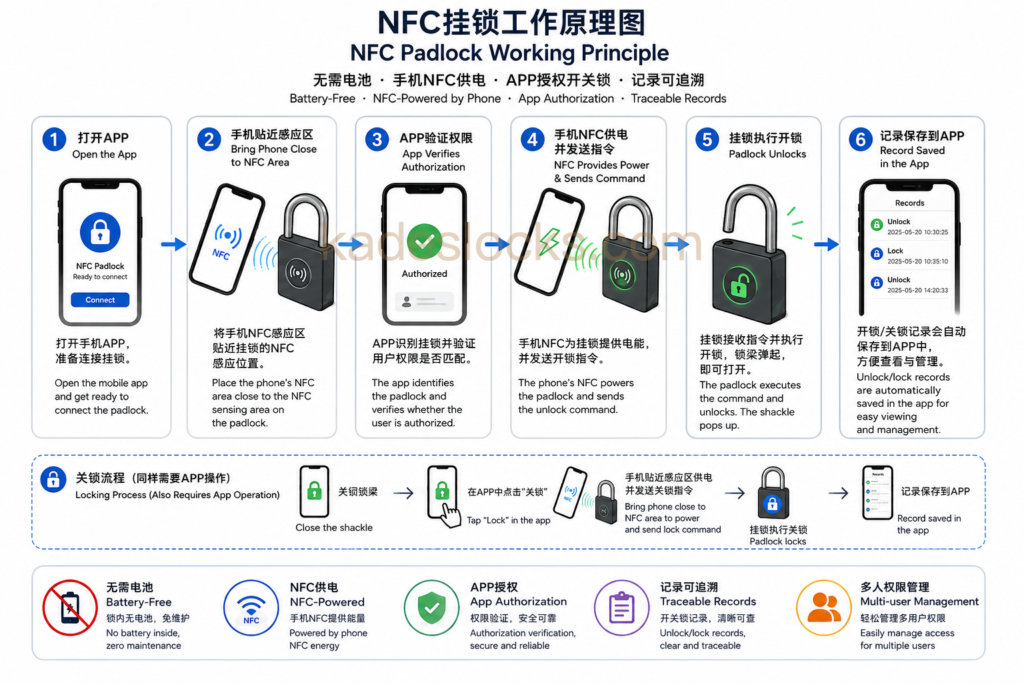
Locking the Padlock Also Requires the App
The NFC padlock can also use the smartphone app to control the locking process.
After closing the padlock, the user selects the lock function in the app and brings the smartphone close to the NFC sensing area again.
The NFC connection provides power to the electronic mechanism, allowing the padlock to complete the locking operation.
This means that both unlocking and locking can be controlled through the authorized smartphone and app.
Why Does the NFC Padlock Not Need a Battery?
One of the most interesting features of this technology is its battery-free design.
Conventional electronic locks normally need an internal battery to power their electronic circuits and locking mechanism. A battery-free NFC padlock instead receives short-duration power from the smartphone through NFC when the phone is placed near the lock.
This approach can provide several practical advantages:
- No internal battery replacement
- No charging port required
- Reduced battery maintenance
- No concern about the lock’s battery becoming depleted during long periods of storage
- Compact electronic design
- Smartphone-based operation
For equipment that may remain unused for extended periods, eliminating the lock’s internal battery can be particularly useful.
Smartphone App-Based Access Control
The NFC padlock is more than an electronic replacement for a traditional key.
Because the locking system works together with a smartphone app, access can be managed digitally.
Depending on the application and software configuration, the system can be designed to support functions such as:
- User authorization
- Padlock identification
- Access permission management
- Unlocking and locking commands
- Operation records
- Digital access history
Instead of distributing physical keys, administrators can manage authorized users through the digital access system.
Access Records and Digital Traceability
Another important advantage of an NFC padlock is the ability to maintain operation records within the mobile app.
Unlocking and locking activities can be recorded by the application, creating a digital history of padlock usage.
This can be valuable for businesses that need better visibility over equipment, storage areas, tools, cabinets, containers, or other assets protected by padlocks.
Digital access records can help answer questions such as:
Who operated the lock? When was it unlocked? When was it locked again?
Compared with a conventional mechanical padlock, this provides a much more traceable approach to access management.
NFC Padlock vs. Traditional Padlock
A traditional padlock is simple and reliable, but its access method is based on a physical key.
An NFC padlock replaces this physical key mechanism with smartphone-based authentication.
| Feature | Traditional Padlock | NFC Padlock |
|---|
| Physical key | Required | Not necessarily required |
| Internal battery | No | No |
| Smartphone operation | No | Yes |
| NFC communication | No | Yes |
| Digital authorization | No | Yes |
| Access records | No | Yes |
| Battery replacement | Not applicable | Not required |
| Digital access management | Limited | Available |
The key difference is not simply the absence of a key. The NFC padlock introduces a digital access management layerwhile retaining the familiar padlock form factor.
Potential Applications of NFC Padlocks
Battery-free NFC padlocks can be considered for a wide range of commercial and industrial applications.
Potential applications include:
Equipment and Tool Management
Companies can use NFC padlocks to control access to equipment, tool storage, maintenance cabinets, and other shared resources.
Storage and Cabinets
The technology can be applied to storage boxes, lockers, cabinets, and other locations where controlled access is required.
Industrial Facilities
Manufacturing facilities may use digital padlocks for restricted equipment, maintenance areas, or shared industrial assets.
Logistics and Asset Management
NFC-enabled access control can also be considered for containers, transport equipment, and other assets that require controlled access and usage records.
Shared Facilities
For locations used by multiple authorized personnel, app-based access management can reduce the need to distribute and recover physical keys.
The Future of Battery-Free Smart Locks
The development of NFC technology is making it possible to rethink how electronic locks receive power and authenticate users.
A battery-free NFC padlock demonstrates an interesting concept: the smartphone can act as both the access credential and the temporary power source for the lock.
By combining NFC communication with app-based authorization, a padlock can become part of a broader digital access-control system without requiring a permanently powered device.
For manufacturers and businesses looking for a smart locking solution with low maintenance requirements, digital traceability, and smartphone-based operation, an NFC padlock offers a practical alternative to both traditional mechanical locks and battery-powered smart locks.
Conclusion
An NFC padlock combines the familiar convenience of a padlock with modern smartphone technology.
Its battery-free design means there is no internal battery to charge or replace. When an authorized smartphone is brought close to the NFC sensing area, the phone can communicate with the lock and provide the power required for electronic operation.
With app-based authorization, NFC power transfer, smartphone control, and digital access records, this type of smart padlock can provide a modern approach to controlled access and asset security.
For applications where maintenance, access management, and traceability are important, battery-free NFC padlocks represent an innovative direction for the next generation of electronic locking solutions.