
Passive Padlock and Electronic Key: How Battery-Free Smart Locking Works

Traditional padlocks rely entirely on mechanical keys, while conventional smart locks require batteries inside the lock body. A Passive Padlock offers a different solution: the padlock itself operates without a built-in battery, while an electronic key provides power, authentication, and communication when it is connected to the lock.
This design combines the reliability of a mechanical padlock with modern electronic access management, making it suitable for industrial equipment, electrical cabinets, utility facilities, warehouses, infrastructure, and other applications requiring controlled access.
What Is a Passive Padlock?
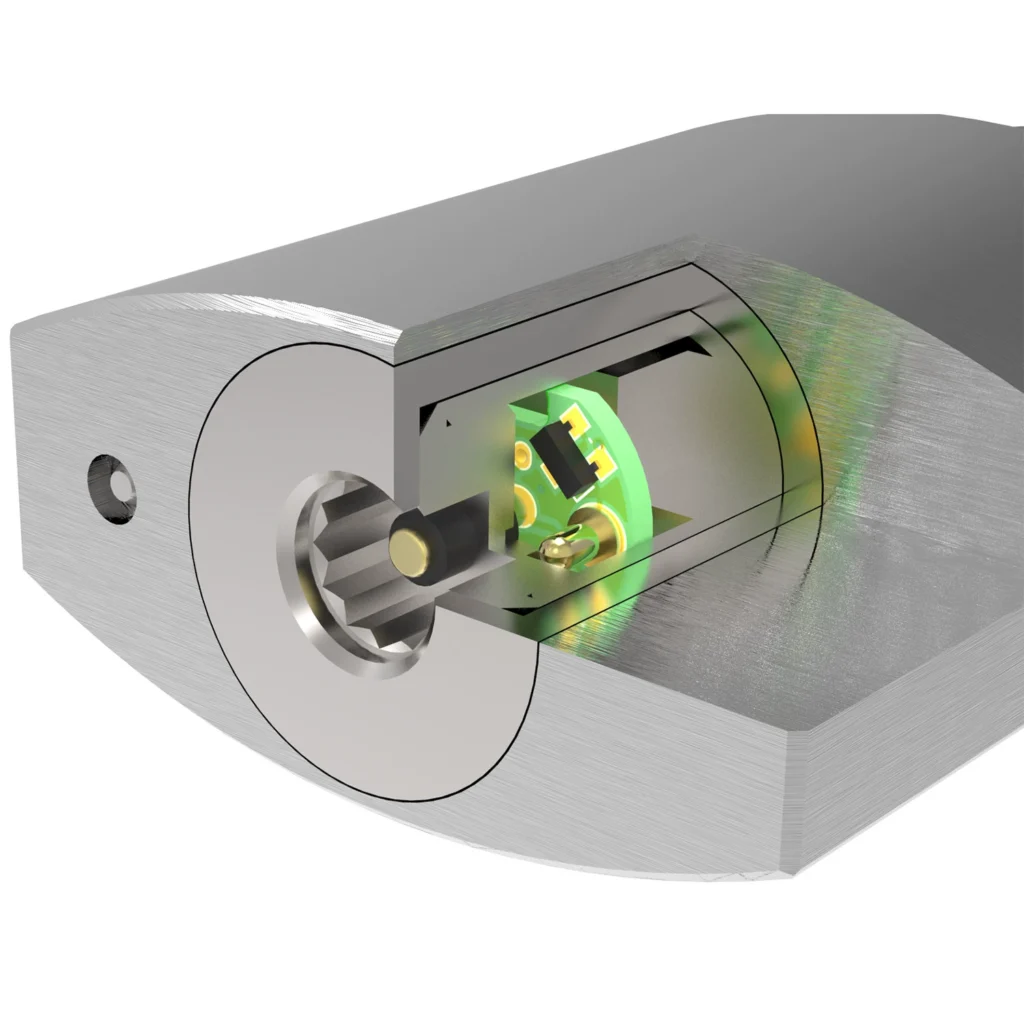
A Passive Padlock is an electronic locking device designed to operate without a permanent power supply inside the padlock.
Instead of installing a battery in every lock, the electronic key supplies the necessary power when it comes into contact with the padlock. The lock can then activate its internal electronic circuit, verify the key’s authorization, and release the locking mechanism when access is approved.
This architecture significantly reduces battery maintenance and makes the locking system suitable for applications where locks may be installed outdoors or in difficult-to-access locations.
How Does a Passive Padlock Work?
The operating process can be divided into several stages.
1. Electronic Key Makes Contact
The user inserts or connects the electronic key to the contact points of the Passive Padlock.
The electrical contacts establish a connection between the key and the lock.
2. The Lock Is Powered
Because the padlock does not contain a permanent battery, the electronic key provides the required electrical energy to activate the lock’s electronic circuit.
This means the padlock only consumes power when it is being accessed.
3. Access Authorization
The electronic key and padlock exchange authentication information.
Depending on the system architecture, secure authentication can use encrypted credentials or challenge-response technology rather than simply transmitting a user ID.
If the key has the correct authorization, the padlock allows the unlocking mechanism to operate.
4. Mechanical Unlocking
After successful authentication, the electronic key can provide the energy required to activate the internal actuator.
The locking mechanism is released, allowing the user to open the padlock.
5. Access Data Is Recorded
The electronic key can record information such as:
- User identification
- Key identification
- Padlock identification
- Date and time of access
- Successful or unsuccessful access attempts
The stored information can later be synchronized with a mobile application and cloud-based management platform.
Bluetooth-Enabled Electronic Key
The electronic key is more than a traditional mechanical key.
It can integrate a rechargeable or replaceable battery, microcontroller, memory, and Bluetooth communication.
After unlocking a Passive Padlock, the key can communicate with a smartphone through Bluetooth. The mobile application can then synchronize access records with a cloud or PC management system through the Internet.
A typical data flow is:
Passive Padlock → Electronic Key → Bluetooth → Mobile App → Cloud Platform → PC Management System
This allows authorized personnel to manage access records without installing a communication module or permanent power source in every padlock.

Battery-Free Padlock, Reduced Maintenance
One of the main advantages of a Passive Padlock is the absence of a built-in battery.
Traditional electronic locks may require batteries to power:
- Bluetooth communication
- Electronic control circuits
- Sensors
- Lock actuators
When hundreds or thousands of locks are deployed, replacing batteries individually can become time-consuming and expensive.
With a passive design, the battery and electronic components are concentrated in the electronic key.
This provides a practical advantage for large-scale deployments where many locks are installed in different locations.
Access Control and Security
A Passive Padlock can provide considerably more control than a conventional mechanical padlock.
Instead of simply having a physical key that can open the lock, an electronic access system can associate a key with a specific authorized user or access level.
For example:
Employee A → Lock 01, Lock 02
Employee B → Lock 03
Maintenance Team → Lock 01–10
Access permissions can therefore be managed according to users, departments, locations, or equipment.
Secure authentication mechanisms can also help prevent unauthorized duplication of electronic keys.
Offline Operation
Another important advantage is that the padlock does not necessarily require a continuous Internet connection.
Access authorization can be stored locally in the electronic key. A user can therefore access equipment even when there is no cellular or Wi-Fi connection at the location.
The access records can be stored temporarily in the key and synchronized with the mobile application later.
This makes the system particularly useful for remote infrastructure, outdoor equipment, construction sites, utility facilities, and other environments where network connectivity may be unavailable.
Applications of Passive Padlocks
Passive electronic padlocks can be used in many industrial and commercial environments, including:
- Electrical cabinets and switchgear
- Telecommunications equipment
- Utility infrastructure
- Industrial machinery
- Construction sites
- Warehouses and logistics facilities
- Railway and transportation infrastructure
- Outdoor equipment
- Energy facilities
- Maintenance and service access points
They are especially useful when equipment needs controlled access but installing and maintaining a battery-powered smart lock at every location would be impractical.
A Smarter Approach to Industrial Access Control
The key concept behind a Passive Padlock is simple: move the power source and communication functions from the lock to the electronic key.
The padlock remains passive until an authorized electronic key is connected. Once connected, the key can supply power, authenticate the user, operate the lock, and record access information.
This architecture combines mechanical durability, electronic authentication, Bluetooth communication, and centralized access management in one system.
For industrial applications with large numbers of access points, a Passive Padlock can provide a practical way to upgrade from conventional mechanical locking to intelligent access control while reducing battery-related maintenance.
Conclusion
A Passive Padlock is not simply a conventional padlock with electronics added to it. It represents a different approach to smart locking.
By eliminating the permanent battery from the padlock and placing the power, intelligence, and communication functions in the electronic key, the system can reduce maintenance requirements while providing secure authentication and detailed access records.
For industrial equipment, infrastructure, and remote facilities, Passive Padlock and Electronic Key technology provides a reliable and scalable solution for modern access control.